
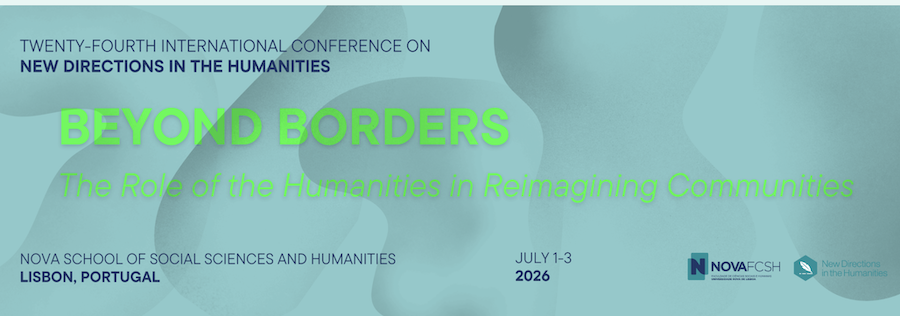
We invite you to join us for the Twenty-Fourth International Conference on New Directions in the Humanities, the annual meeting of the New Directions in the Humanities Research Network, taking place 3–5 June 2026 in Lisbon, Portugal and online, in partnership with our host institution, NOVA School of Social Sciences and Humanities. This year the conference is held alongside the Twenty-Fourth International Conference on Publishing Studies, the annual meeting of the Information, Medium & Society – The Publishing Studies Research Network, reflecting shared commitments to understanding how meaning, culture, and knowledge circulate within and across communities. Together, these Networks bring into dialogue scholars, educators, writers, artists, publishers, editors, technologists, librarians, designers, policymakers, and cultural workers engaged in examining how the humanities and publishing shape public life, cultural expression, and the structures through which knowledge is produced and shared.
In 2026, our shared gathering brings together two complementary Special Focus themes. For the Humanities Network, “Beyond Borders: The Role of the Humanities in Reimagining Communities” invites participants to consider how communities are formed, negotiated, and transformed in an era marked by deepening national, ideological, economic, cultural, and epistemological divides. As inherited frameworks of belonging are strained by migration, digital mediation, planetary crisis, and political polarisation, the humanities offer powerful tools for interrogating the boundaries that separate and the narratives that bind. For the Publishing Studies Network, “Beyond Borders: Democratizing Knowledge in a Polarized World” asks how publishing—across print, digital, and hybrid forms—can dismantle linguistic, geographic, technological, and ideological barriers to participation in knowledge cultures. Taken together, these themes ask how communities and publics are imagined, sustained, and contested, and how the humanities and publishing together can support more open, dialogic, and equitable ways of knowing and belonging.
Lisbon provides a resonant setting for these conversations. As a city shaped by centuries of maritime exchange, imperial expansion, migration, and cultural layering, Lisbon has long stood at the intersection of circulation and encounter. Its historical and contemporary landscapes offer a living context for exploring how narratives, texts, images, archives, and publishing infrastructures mediate relationships among peoples, places, and times, and how these mediations shape the communities we inherit and those we seek to build.
Across the two Networks, we welcome papers examining how communities are imagined, represented, and lived; how narratives travel and transform across media and contexts; how publishing infrastructures support or constrain participation; and how humanistic inquiry exposes or redresses histories of inequality, exclusion, invisibility, or erasure. The conference invites research on movement and travel, on gendered and racialised spaces, on the ethics of coexistence, and on political imaginaries that sustain or challenge belonging. It equally invites examinations of the material and immaterial circulations—books, manuscripts, images, sounds, data, and stories—that create transregional or transhistorical communities, and of the editorial, curatorial, and technological decisions that shape the life of knowledge across borders.
Alongside this shared special focus, the Humanities Network welcomes proposals addressing its ongoing concerns in critical cultural studies, literary and textual humanities, languages and linguistics, humanistic education, and digital humanities. The Publishing Studies Network welcomes work engaging its annual themes of Informational Foundations, Mediums of Disruption, and Social History and Impacts, with attention to authorship, editorial practice, translation, access, platformisation, design, metadata, and the political and economic forces shaping global information systems. We encourage proposals from all disciplinary backgrounds and methodological traditions that explore how the humanities and publishing—together and separately—help us understand, challenge, and reimagine the social, cultural, and intellectual formations of our time.
Knowledge Experience and Format
The conference is organised as a hybrid knowledge experience, integrating in-person and online participation within a unified scholarly environment. All accepted proposals become Presentation Pages, where presenters upload abstracts, media, and reflections, and where delegates engage in discussion before, during, and after the event.
In-person presentations in Lisbon, live online sessions, and asynchronous contributions are woven together into a single integrated program. Regardless of participation mode, all delegates have access to the full schedule, session media, and a growing digital archive. Across all formats, the emphasis is on reciprocal, human-scale scholarly exchange—conversation, reflection, and collaborative inquiry rather than one-directional presentation.
Proposal Periods
Proposals will be reviewed within two to four weeks of submission.
| Early | Launch to 30 November (25) | |
| Regular | 1 December (25) to 31 March (26) | |
| Late | 1 April (26) to 1 June (26) |
Registration Periods
The digital media deadline is one week before the conference.
| Early | Launch to 31 December (25) | |
| Regular | 1 January (26) to 31 May (26) | |
| Late | 1 June (26) to 1 July (26) |